Monoblock pumps , also known as screw pumps, are used in various industries due to their unique design and high performance in pumping dense liquids and solids. However, every industrial plant also has disadvantages. Despite the numerous advantages of monoblock pumps, there are also disadvantages that must be considered before selecting and using them.
In this article, we’ll take a closer look at the disadvantages of single-stage pumps and share some key points to help you make a more informed decision when buying and using these pumps.
1. The initial cost is relatively high.
The first thing you’ll notice when buying a single-stage pump is that it’s more expensive than many centrifugal or gear pumps . because of its more complex design, special components (such as a durable rubber stator), and high manufacturing precision.
For smaller industries or applications that do not require pumping specific fluids, these costs can be a significant limitation.
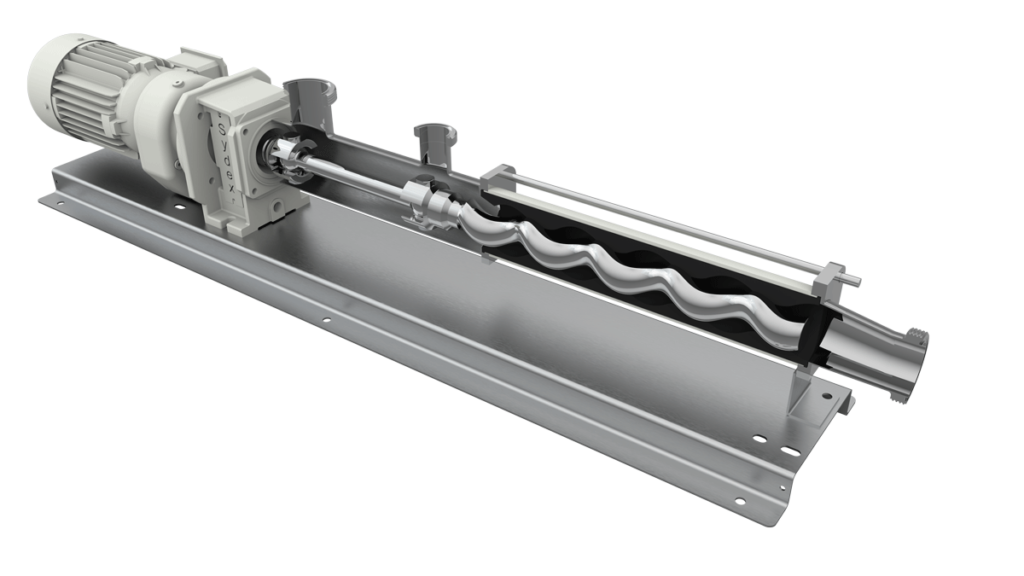
2. Dry-run sensitivity
One of the biggest drawbacks of a single pump is its tendency to run dry .
-
When the pump runs dry, high temperatures are generated due to the high friction between the metal rotor and the rubber stator.
-
These temperatures can cause the stator to burn out, bend or crack.
-
High maintenance costs and production downtime are therefore unavoidable.
Therefore, the use of protection systems such as dry-running sensors or flow control valves is necessary.
3. High corrosion in abrasive liquids
Although monopumps are capable of conveying liquids with solids, excessive wear and tear of the rotor and stator occurs when used constantly with abrasive materials such as sand or drilling mud .
-
Fixed rubber parts have a shorter lifespan, especially when exposed to abrasive particles.
-
Metal rotors can also corrode or scratch if exposed to hard particles for long periods of time.
This leads to increased costs for maintenance and parts replacement.
4. Temperature and Material Restrictions
-
The stator of a single pump is usually made of rubber or a flexible material.
-
These materials have limited temperature stability and decompose at very high temperatures (usually above 120–150 °C).
-
Some chemical liquids can also cause rubber to swell, melt, or crack .
Therefore, the use of single-stage pumps in industries that work with hot liquids or highly corrosive chemicals requires careful selection of stator materials.

5. Relatively large size and weight.
Due to the special design of the rotor and stator, single-head pumps are usually longer and heavier than centrifugal pumps.
-
This can be a problem in small spaces or areas with limited installation space.
-
In addition, the shipping and installation costs are higher.
6. Efficiency depends on working conditions.
Although a single pump works well at high pressure and constant flow, its efficiency decreases : under certain conditions
-
High liquid temperatures can cause the stator to soften and efficiency to decrease
-
Sudden changes in viscosity can affect performance.
-
Prolonged use may cause internal leakage between the rotor and stator.
7. Requires professional maintenance and repair.
Due to their special design, single-stage pumps require regular professional maintenance .
-
Stator replacement must be carried out by trained personnel .
-
The slightest mistake during assembly can shorten the life of the part.
-
In the case of severe corrosion , repairs take a long time and can lead to a standstill of the production line.
8. Limit extremely high flow rates.
Single-stage pumps are best for pumping thick and medium-volume liquids.
-
When very high flow rates are required (e.g. thousands of cubic meters per hour), the use of these pumps is economically unprofitable.
-
In this case, a centrifugal pump would be the best option.
9. Vibration and noise under unsuitable conditions
Although single-stage pumps generally have uniform conductivity , problems can occur in the following cases:
-
Column misalignment
-
Wrong choice of gearbox or clutch
-
Or the stator is worn
They generate significant vibration and noise, which reduces efficiency and shortens the lifespan of peripherals.
10. High cost of spare parts
The main disadvantage of mono pumps is the high cost of spare parts, especially for the stator and rotor .
-
The stator has the highest failure rate due to direct contact with the liquid and constant wear .
-
The price of these components is higher on the market than the price of many conventional pumps.
-
This will lead to increased maintenance costs in the industry.
Whirlling International Product Catalog
Disadvantages of single-stage pumps compared to other pumps
| Feature | A pump | Centrifugal | Gear Pumps |
|---|---|---|---|
| Historical cost | higher | less | Half |
| Dry matter sensitivity | Very much | Half | A little |
| Solids compatibility | Medium (high wear) | weak | weak |
| Temperature limit | Yes (corrected) | less | less |
| Size and weight | many | less | Half |
| Professional service required | higher | Half | Half |
Basic troubleshooting tips for single-stage pumps
Although the above disadvantages are serious, they can be significantly reduced by following a few tips:
-
Please select the stator material correctly according to the type of liquid (NBR, EPDM, FKM , etc.).
-
Use protection systems such as dry-running sensors or bypass valves.
-
Carry out regular maintenance to avoid excessive wear .
-
Choose the right gearbox and gearbox to reduce vibration and noise.
-
Before buying, carefully consider the life cycle cost (LCC), not just the initial cost.
At last
Single pumps are powerful tools that are widely used in many different industries. However, using them without knowledge of their defects and limitations can lead to high maintenance costs and loss of production.
The main disadvantages of mono pumps:
-
High acquisition costs and large amount of spare parts
-
Very sensitive to dry running.
-
High corrosion in abrasive liquids
-
Chemical and temperature limits of the stator
-
Bigger and heavier than other bombs.
However, with proper material selection and construction, as well as regular maintenance, single-stage pumps remain one of the best options for transporting thick and specialized fluids.